🏡 2025 Land Tax Secrets: How It Could Rewrite Your Investment Plans
Whether you’re a seasoned investor or just starting your property journey, understanding land tax is critical to protecting your returns in 2025 and beyond. With updates rolling out across New South Wales, Victoria, Queensland and more, many investors are waking up to a reality that their current strategy might need a serious rethink.
In this guide, we break down the essentials—what land tax is, how it works in each state, and the hidden traps you’ll want to avoid.
📘 What Is Land Tax?
Land tax is a state-based tax levied on the unimproved value of the land you own, excluding your principal place of residence in most cases. It’s typically assessed annually and calculated by your state’s revenue office.
But here’s the catch: each state and territory has its own rules, thresholds, and rates. That means if you own property across multiple jurisdictions—or plan to—you need to understand how land tax affects your cash flow in each one.
🏘️ Which Types of Properties Are Subject to Land Tax?
Generally exempt:
- Your Principal Place of Residence (PPR)
- Primary production land (e.g., farms)
- Charitable organisations
Typically liable for land tax:
- Investment properties
- Holiday homes
- Vacant residential land
- Properties owned via trusts or companies
If you’re holding multiple properties, expect to be assessed on the aggregated land value across your holdings in a given state.
📊 How Is Land Tax Calculated?
While each state has its quirks, most follow a similar three-step structure:
- Valuation: Your land’s value (excluding buildings) is assessed by the Valuer-General of the state.
- Threshold: You pay tax only if the value exceeds the state-specific threshold.
- Rate: A progressive rate is applied—meaning the more valuable the land, the more tax you pay.
Some states also include surcharges for absentee owners, foreign investors, or vacant land penalties.
📅 Land Tax Concepts Every Investor Should Know
🗓️ Taxing Date
Each state sets an official “taxing date” to determine the ownership and value of land for that year’s assessment. For example, Victoria uses 31 December, while most other states use 30 June.
📄 Clearance Certificate
Before buying a property, request a Land Tax Clearance Certificate to ensure there’s no outstanding liability that you could inherit at settlement.
🏷️ Valuer-General’s Role
They determine your land’s value for taxes, which may differ from its market or sale price.
📍 State-by-State Highlights for 2025
Victoria
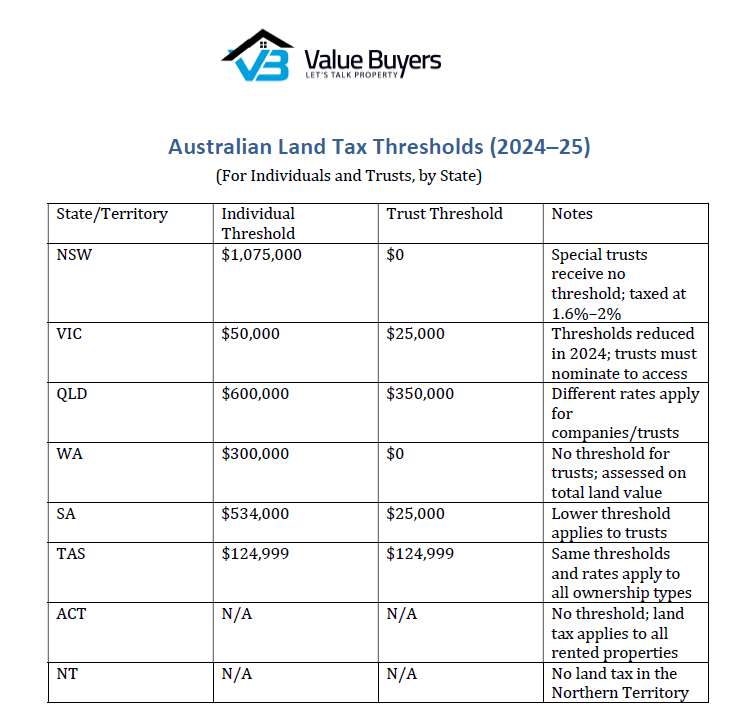
- Progressive tax rates start at $50,000 land value.
- Vacant Residential Land Tax (VRLT) now applies state-wide from Jan 2025.
- VRLT surcharges increase annually for ongoing vacancies (1% → 3%).
- 7.5% short-stay levy introduced for Airbnb/holiday rentals.
New South Wales
- Land tax thresholds frozen at $1,075,000 (general) and $6,571,000 (premium) until mid-2027.
- Foreign Owner Surcharge raised to 5%.
- New PPR exemption rule: owners must hold at least 25% interest from Feb 2024.
Queensland
- Threshold: $600,000 for individuals, $350,000 for trusts/companies.
- Rates range from 1% to 2.75%.
- No indexation of thresholds despite surging property values.
- South Australia, Western Australia, Tasmania, ACT
- Varying thresholds and progressive rates apply.
- ACT applies quarterly taxing dates.
- NT has no land tax.
💰 The Investment Impact: Why Land Tax Matters More Than Ever
If you’re an investor, land tax isn’t just a line item—it’s a strategic lever. It can:
- Reduce your net rental yield.
- Impact capital growth strategy.
- Influence your choice of state for future purchases.
Failing to plan for land tax can erode your profits or even leave you exposed to unexpected liabilities—especially if you cross state lines or hold multiple assets.
🔎 How to Estimate Land Tax Before Buying
- Use online calculators available on each state’s revenue website.
- Request a clearance certificate before purchasing.
- Engage a professional to do multi-state land tax forecasting.
Pro tip: Just because a property looks like a good deal on paper doesn’t mean it won’t come with a land tax sting. Crunch the numbers before you commit.
🧠 Plan Smart: Strategic Moves to Minimize Land Tax
- Structure matters: Consider using trusts or companies to manage thresholds—but get legal advice.
- Diversify across states: Spread your portfolio to balance liabilities.
- Time your purchases: A strategic settlement date could shift your taxing year and reduce liability.
👩💼 Why a Buyer’s Agent Can Help You Stay Ahead
At face value, land tax sounds like just another cost. But the real danger is not knowing when and where it applies—or how it affects your ROI.
This is where working with a buyer’s agent who understands land tax intricacies can be invaluable. Not to sell you anything—but because getting this wrong could mean thousands in unnecessary tax or poor investment performance.
The right advice upfront could:
- Help you buy smarter.
- Reduce long-term holding costs.
- Avoid unpleasant surprises at settlement.
📌 Final Thoughts
Land tax in 2025 is more complex, stricter, and costlier in many states. But with the right insights and planning, it doesn’t have to be a dealbreaker.
Whether you’re a first-time investor or growing a national portfolio, understanding the real cost of land tax—and how to minimize it—can dramatically improve your investment success.
Stay smart. Stay strategic. And above all, stay informed.